
TS2023 Work Permit Extension – Petition did not Succeed
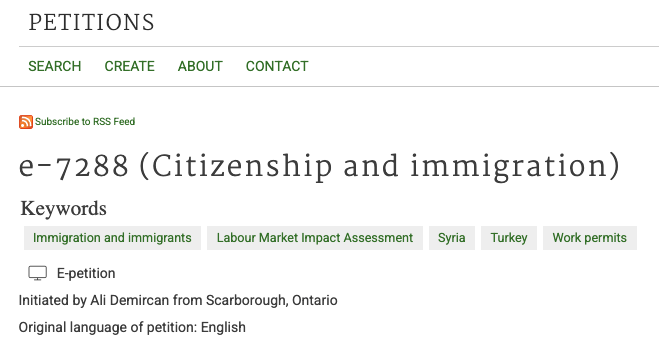
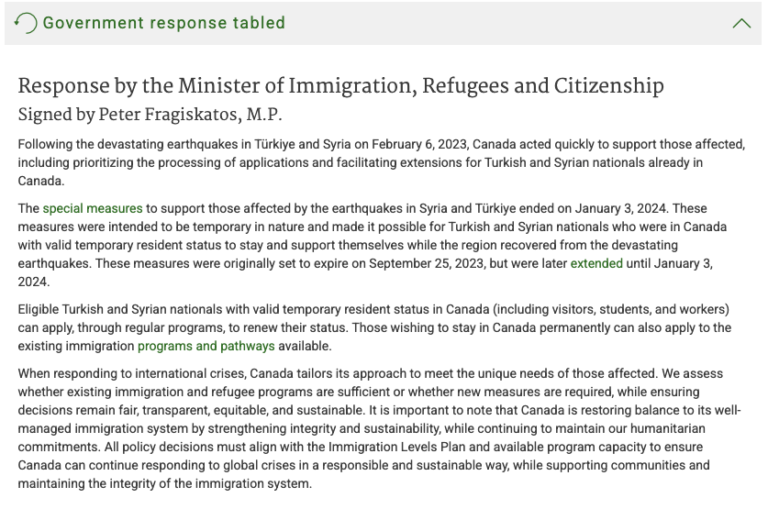
Many Turkish and Syrian nationals in Canada have been waiting to learn whether there would be a TS2023 work permit extension or a new immigration pathway for people affected by the 2023 Türkiye–Syria earthquakes. The Government of Canada has now responded to Petition e-7288 and confirmed that the TS2023 special measures ended on January 3, 2024. The petition had asked the government to create LMIA-exempt work permits, provide at least a 24-month extension, and consider a pathway to permanent residence for TS2023 beneficiaries. In response, the government stated that the measures were temporary and that eligible Turkish and Syrian nationals who wish to remain in Canada must now apply through regular temporary or permanent residence programs.
What Was TS2023 and Why Was It Created?
TS2023 was Canada’s temporary immigration response to the devastating earthquakes that struck Türkiye and Syria on February 6, 2023. The disaster included a 7.8 magnitude earthquake followed by another major earthquake later the same day, causing widespread destruction across southern and central Türkiye and northern and western Syria. The earthquakes caused severe damage, tens of thousands of deaths, and large-scale displacement.
The United Nations described the disaster as one of the biggest to affect the region in recent times, noting that thousands of buildings collapsed, many people were exposed to winter conditions, and schools and hospitals were destroyed.
In that context, Canada introduced special temporary measures for certain Turkish and Syrian nationals who were already in Canada with valid temporary resident status. The purpose was not to create a permanent immigration program, but to give affected people more time and flexibility to remain in Canada while conditions in the earthquake-affected region stabilized.
In the government’s response to Petition e-7288, IRCC stated that the measures helped eligible Turkish and Syrian nationals in Canada stay and support themselves while the region recovered, and that Canada also prioritized processing and facilitated extensions for those affected.

What the Government Said in Response to Petition e-7288
Petition e-7288 asked the Government of Canada to do three things for TS2023 beneficiaries: create access to LMIA-exempt work permits, provide a minimum 24-month work permit extension, and consider a pathway to permanent residence for affected people who had established themselves in Canada through work, school, or community ties. The government did not accept those requests as a new TS2023 extension or dedicated TS2023 pathway. Instead, the response stated that the special measures ended on January 3, 2024, that they were intended to be temporary, and that Turkish and Syrian nationals who wish to remain in Canada must now look to regular temporary residence extensions or existing permanent residence programs.
How the 2026–2028 Immigration Levels Plan Relates to the TS2023 Decision
The government’s response to Petition e-7288 connects the decision not to create a new TS2023 work permit extension to Canada’s broader immigration planning. In particular, the response states that decisions about crisis-related immigration measures must align with the Immigration Levels Plan and available program capacity. The 2026–2028 Immigration Levels Plan reflects a shift toward lower temporary resident arrivals, with IRCC stating that Canada is working to reduce the temporary resident population to less than 5% of the total population by the end of 2027. The supplementary plan sets new temporary resident arrival targets at 385,000 in 2026 and 370,000 in 2027 and 2028, while permanent resident admissions are stabilized at 380,000 per year.
In practical terms, this helps explain why the government may be reluctant to create another broad temporary public policy for TS2023 beneficiaries, even where many affected people have strong humanitarian and community-based reasons for wanting to remain in Canada. The plan does not eliminate humanitarian commitments, but it places new emphasis on managing temporary resident volumes, prioritizing economic immigration, and transitioning selected people already in Canada to permanent residence through defined programs rather than broad extensions.
What This Means for TS2023 Work Permit Holders
For people who received status or work authorization through TS2023, the government’s response means there is no automatic new extension and no dedicated TS2023 permanent residence pathway at this time. Affected workers should treat their situation as time-sensitive and carefully review their current status, work permit expiry date, employer support, family circumstances, Canadian work experience, language ability, and long-term immigration goals.
Depending on the facts, some may need to consider temporary status options, while others may be better positioned to explore permanent residence pathways such as Express Entry, a Provincial Nominee Program, the Rural Community Immigration Pilot, family sponsorship, or another program. The important point is that affected applicants should broaden the scope of their analysis beyond TS2023 and assess how any available pathway fits within the bigger picture of their overall immigration strategy in Canada.
Alternative Immigration Pathways May Need to Be Considered
The end of TS2023 does not mean that every affected person has the same immigration options, or that one pathway will fit every case. For many Turkish and Syrian nationals, the next step is to look beyond the expired special measure and assess whether their work history, employer support, language ability, education, location in Canada, family situation, and long-term goals may fit another temporary or permanent residence pathway.
One example is the Rural Community Immigration Pilot, which IRCC describes as a permanent residence pathway for skilled workers who want to work and settle in rural and more remote communities. The program depends on factors such as a valid job offer from a designated employer, community recommendation, work experience, language ability, education, and settlement funds, so it should be assessed carefully in the context of the person’s full immigration strategy.
What is an LMIA-Exempt Work Permit?
An LMIA-exempt work permit is a work permit that may be issued without the employer first obtaining a Labour Market Impact Assessment, commonly called an LMIA. An LMIA is the process where Employment and Social Development Canada assesses whether hiring a foreign worker is likely to have a positive or neutral effect on the Canadian labour market.
LMIA-exempt work permits are not a general alternative available to everyone. They apply only in specific situations recognized under Canada’s International Mobility Program, such as certain international agreements, Canadian-interest categories, permanent residence-related work permit options, or other defined exemptions.
A person who held status under TS2023 does not become eligible for an LMIA-exempt work permit for that reason alone. Where no LMIA-exempt category or other immigration option fits the facts, an employer-supported LMIA-based work permit may need to be explored, provided the employer and position can meet the regular LMIA requirements.
Practical Steps for Affected TS2023 Workers
For affected TS2023 workers, the most important step is to move from uncertainty to a clear immigration strategy. Since the government has not announced a new TS2023 extension or dedicated permanent residence pathway, individuals should consider whether they may qualify under another temporary or permanent residence option.
This could include employer-supported pathways, permanent residence programs, regional immigration pilots, family-based options, or other categories, depending on the specific facts of the case. The right approach will not be the same for everyone, and timing may be important where a work permit or temporary status is approaching expiry. A personalized review can help identify which options may be realistic, which risks should be considered, and how a possible next step may fit within the person’s broader goal of remaining in Canada.
Request a Consultation with Ash
Looking for a Canadian immigration lawyer in Victoria BC? Ash Forghani is a Canadian immigration lawyer in Victoria and also assists clients in Vancouver BC, across Canada, and worldwide with their Canadian immigration law matters. Whether you need assistance with a visitor visa, super visa, work permit, study permit, restoration of status, BC PNP, permanent residence, or Canadian citizenship, Ash is here as your trusted immigration lawyer.
