
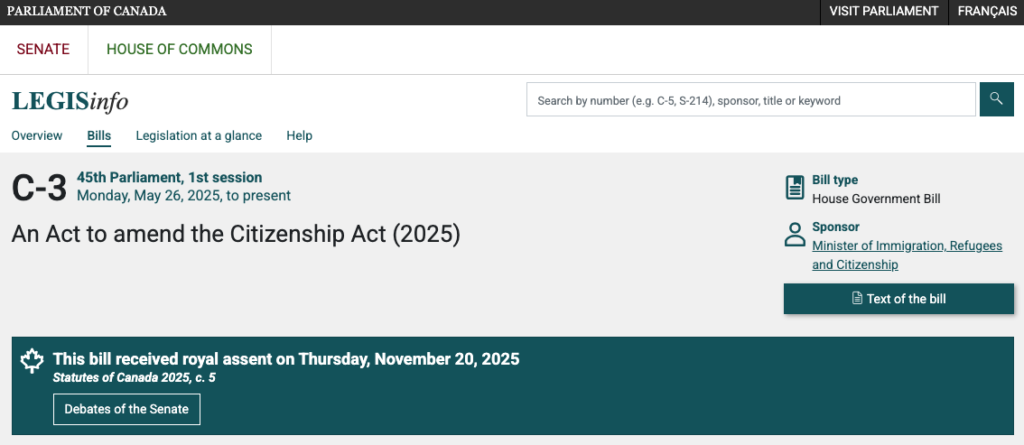
Bill C-3 marks one of the most significant recent changes to Canadian citizenship law for families with roots outside Canada. The amendments respond to a long-standing problem in the Citizenship Act: the former first-generation limit on citizenship by descent, which prevented many Canadian citizens born abroad from automatically passing citizenship to their own children also born abroad.
Bill C-3 received Royal Assent on November 20, 2025, and its key citizenship-by-descent amendments came into force on December 15, 2025.
The result is a more inclusive citizenship framework, but not a completely open-ended one. For many people born outside Canada to a Canadian parent before December 15, 2025, Canadian citizenship may now exist by operation of law. For children born abroad on or after that date, the analysis is different: citizenship beyond the first generation will often depend on whether the Canadian parent can show a substantial connection to Canada, by showing at least 1,095 cumulative days of physical presence in Canada before the child’s birth.
The Rule Before Bill C-3
Before Bill C-3, Canadian citizenship by descent was restricted by what became known as the first-generation limit. In general terms, a person born outside Canada could acquire Canadian citizenship automatically if they were born to a Canadian parent who was either born in Canada or naturalized in Canada. But if the Canadian parent was also born abroad and acquired citizenship by descent, that parent often could not automatically pass Canadian citizenship to a child also born abroad.
The practical effect was severe and, in some cases, unfair. A Canadian citizen born outside Canada was fully Canadian, but could still be unable to transmit citizenship to their own child in the same way as a Canadian born or naturalized in Canada. This created two types of Canadian citizens: those who could pass citizenship by descent to children born abroad, and those who could not.
That distinction affected many families with genuine ties to Canada. Canadians who lived abroad for work, study, military service, family obligations, or temporary residence could find that their children were excluded from automatically acquiring Canadian citizenship even where the family maintained a real connection to Canada. Families were sometimes forced into discretionary applications, immigration sponsorship, temporary status, or prolonged uncertainty about whether their children had a secure right to live in Canada.
The Bjorkquist Decision
The constitutional turning point was Bjorkquist et al. v. Attorney General of Canada, 2023 ONSC 7152. In December 2023, the Ontario Superior Court of Justice found that the former second-generation cut-off in the Citizenship Act was unconstitutional in important respects because it unjustifiably limited rights protected by the Canadian Charter of Rights and Freedoms, including mobility and equality rights.
The decision exposed the core flaw in the old law. The problem was not simply that Parliament had drawn a line. The problem was that the line treated Canadian citizens differently based on the circumstances of their own birth and the place where their Canadian parent happened to be when they were born. Canadians born abroad remained Canadian citizens, but could have a restricted ability to pass that citizenship to their own children.
The applicants’ stories showed how the rule affected families with genuine ties to Canada.
In the Chandler family, Patrick Chandler was born abroad but returned to Canada as a child, completed his elementary, secondary, and university education in Canada, and later tried to return to British Columbia with his family. His children, born in Beijing, were denied automatic citizenship, and he returned to Canada alone to begin immigration processes before the family could reunite.
In the Kenyon-Warelis family, both parents were Canadian citizens by descent who had spent significant parts of their lives in Canada, including education and public-sector work. Their child, born in Hong Kong, was left without citizenship status and was in fact born stateless. The family had to seek discretionary relief and leverage contacts within IRCC to eventually obtain Canadian citizenship for their child. These are examples of practical hardships affecting Canadian families because of the first-generation limit.
Bill C-3 was Parliament’s legislative response. Rather than leave the former first-generation limit in place, Parliament amended the Citizenship Act to recognize more people as citizens and to create a new rule for future cases where citizenship is claimed beyond the first generation.
What Bill C-3 Changed
Bill C-3 changed the law in two main ways.
First, it addressed people born abroad before the new law came into force. IRCC states that citizenship may have been restored or given to people born outside Canada in the second generation or later before December 15, 2025. In most cases, a person born before that date outside Canada to a Canadian parent may now be automatically Canadian, including where the parent became Canadian because of the rule changes.
Second, Bill C-3 created a new framework for people born abroad on or after December 15, 2025. For future second-or-later-generation cases, citizenship can still pass beyond the first generation, but only if the Canadian parent meets the substantial-connection requirement. The central test is whether the parent accumulated at least 1,095 days of physical presence in Canada before the child’s birth.
The amended law is more generous than the former first-generation limit, but it still imposes conditions. A person’s eligibility depends heavily on the date of birth, the citizenship status of the parent, and the parent’s connection to Canada.
People Born Abroad Before December 15, 2025
For many people born outside Canada before December 15, 2025, Bill C-3 may have changed the answer to a basic question: Am I a Canadian citizen?
For this group, the amended law may recognize citizenship automatically where the person was born abroad to a Canadian parent, even if that parent was also born abroad or became Canadian because of Bill C-3. Unlike future cases, the new 1,095-day substantial-connection test does not apply to people born before December 15, 2025.
The result still depends on many factors such as the person’s date of birth, the parent’s citizenship history, and how citizenship passes through the family under the amended Act. A prior refusal or old legal opinion may no longer be reliable, but it also does not guarantee that citizenship now exists.
The practical point is that people born abroad before December 15, 2025, who were previously affected by the first-generation limit may wish to have their situation reassessed under the new rules.
Children Born Abroad On or After December 15, 2025
For children born outside Canada on or after December 15, 2025, the amended law uses a different framework.
Citizenship beyond the first generation may still be available, but only if the Canadian parent meets the new substantial-connection requirement. This means showing that the parent accumulated at least 1,095 days of physical presence in Canada before the child’s birth.
The days do not need to be consecutive, but the parent must be able to establish enough qualifying time in Canada before the child was born. Whether that requirement is met can depend on the parent’s personal history, records, and the way the amended Act applies to the family.
This is one of the most important changes under Bill C-3. The law no longer treats all second-or-later-generation claims as automatically barred, but it also does not allow citizenship to continue indefinitely through successive generations born abroad without a demonstrated connection to Canada.
Conclusion
Bill C-3 substantially changed Canadian citizenship by descent. It corrected much of the unfairness created by the former first-generation limit and opened citizenship to many people who were previously excluded.
But the amended law must still be applied carefully. For people born abroad before December 15, 2025, citizenship may now exist automatically in some cases. For children born abroad on or after that date, citizenship beyond the first generation will depend on whether the Canadian parent can meet the new 1,095-day substantial-connection requirement.
The safest conclusion is this: anyone previously told that Canadian citizenship by descent was unavailable should not assume that answer remains correct. Bill C-3 changed the legal framework, and many families now need a fresh assessment under the amended Citizenship Act.
Request a Consultation with Ash
Looking for a Canadian immigration lawyer in Victoria BC? Ash Forghani is a Canadian immigration lawyer in Victoria and also assists clients in Vancouver BC, across Canada, and worldwide with their Canadian immigration law matters.
If you or a family member may be affected by Bill C-3, contact our office to Request a Consultation with our immigration lawyer, Ash Forghani, and review how the amended citizenship rules affect you.
Whether you need assistance with a visitor visa, super visa, work permit, study permit, restoration of status, BC PNP, permanent residence, or Canadian citizenship, Ash is here as your trusted immigration lawyer.
