
What is Canada’s Immigration Levels Plan?
Canada’s Immigration Levels Plan is the federal government’s annual outline of how many people it aims to admit as permanent residents, along with its expected intake of new temporary workers and international students over the next three years.
Historically, the plan focused only on permanent resident admissions. It has since been expanded to include annual targets for certain categories of new work and study permit arrivals, reflecting the broader role temporary residents play in Canada’s immigration system.
Each year, the Immigration Levels Plan is tabled in Parliament as part of the government’s official immigration report. This process requires policymakers to regularly review labour market trends, demographic pressures, and capacity considerations such as housing, infrastructure, and essential services.
Although the plan does not set every operational detail of IRCC programs, it clearly signals the government’s immigration priorities and the areas it intends to emphasize in the near term.
For prospective applicants, the Immigration Levels Plan provides insight into the direction of Canada’s immigration policy. It highlights the planned balance across economic, family, and humanitarian permanent resident categories and offers an indication of how new work permits and study permits are expected to be managed.
In the 2026–2028 Immigration Levels Plan, for example, the government introduced a substantial reduction in projected temporary resident levels, emphasizing a shift toward closer management of temporary entries. Understanding these priorities can help workers, students, and permanent residence applicants interpret Canada’s evolving immigration strategy without relying solely on past patterns.
Canada’s Immigration Landscape has been Recalibrated
On November 5, 2025, Canada released the 2026 – 2028 Immigration Levels Plan and framed it as a return to what it describes as more “sustainable” immigration levels after several years of rapid growth with temporary residents reaching its peak of more than 7.5 percent in 2024. While the earlier 2025 – 2027 plan had already set permanent resident admissions at 380,000 for 2026, the new plan keeps that level and raises the 2027 total from its previously projected 365,000 to 380,000, holding annual admissions steady through 2028.
IRCC notes that these levels sit below 1 percent of Canada’s population and maintains economic immigration as the largest share through expanded Federal High Skilled and Provincial Nominee Program spaces. The plan also sets rising francophone targets outside Quebec, reaching 10.5 percent by 2028, and introduces two one-time pathways that will transition approximately 115,000 protected persons and up to 33,000 temporary workers already in Canada to permanent residence over 2026 and 2027.
The more significant shift appears on the temporary resident side. The new plan replaces the far higher temporary resident projections in the earlier 2025 to 2027 plan with much lower targets for workers and students, reflecting the government’s commitment to reduce the temporary resident population to less than 5 percent of Canada’s total population by the end of 2027 from its peak of more than 7.5 percent in 2024.
New temporary resident arrivals are now targeted at 385,000 in 2026 and 370,000 in both 2027 and 2028, well below the earlier projections of 516,600 and 543,600 for those years. Budget 2025 situates these reductions within a wider economic strategy that links temporary resident declines to housing pressures, public service capacity and labour market conditions as part of a broader return to what it considers sustainable levels, though whether these sharply lower targets will meaningfully address those issues is far from settled.
This article demonstrates that Canada’s approach to immigration has shifted. Among the many changes, Canada has:
- fixed permanent resident admissions below 1 percent of the Canadian population;
- introduced limited one-time pathways for certain groups already in Canada;
- expanded space for Federal High Skilled and Provincial Nominee Program applicants;
- raised francophone immigration targets for applicants from outside Quebec; and
- sharply reduced its temporary resident intake.
For anyone considering permanent residence, temporary work, or study, the central question is how their own plans align with these priorities. In this article, I explain the direction of Canada’s policy in 2026 and what it likely means for economic immigrants, workers, and students over the next three years.
Permanent Resident Admissions Fixed at 380,000 per Year
The 2026 – 2028 Immigration Levels Plan makes one clear adjustment to Canada’s permanent resident intake: it holds the annual admissions ceiling at 380,000 for three consecutive years and removes the decline that had been scheduled under the previous plan. The 2025 to 2027 plan set 2026 at 380,000 but planned to lower 2027 to 365,000.
The new plan keeps 2026 at 380,000, raises 2027 to match it, and maintains the same ceiling through 2028. IRCC presents this as a move toward “sustainable” levels and notes that the ceiling remains below 1 percent of Canada’s population, though it does not explain why that threshold should define “sustainability.” Each annual target is also paired with a low and high range to give IRCC flexibility to respond to operational pressures. For example, the earlier 395,000 target for 2025 carried a permissible range of 367,000 to 436,000. These ranges do not change the target itself but reflect how far actual admissions may vary in practice.
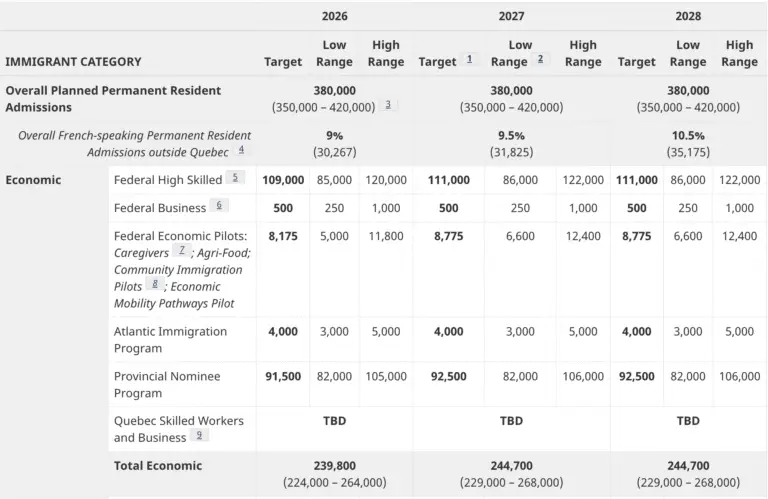
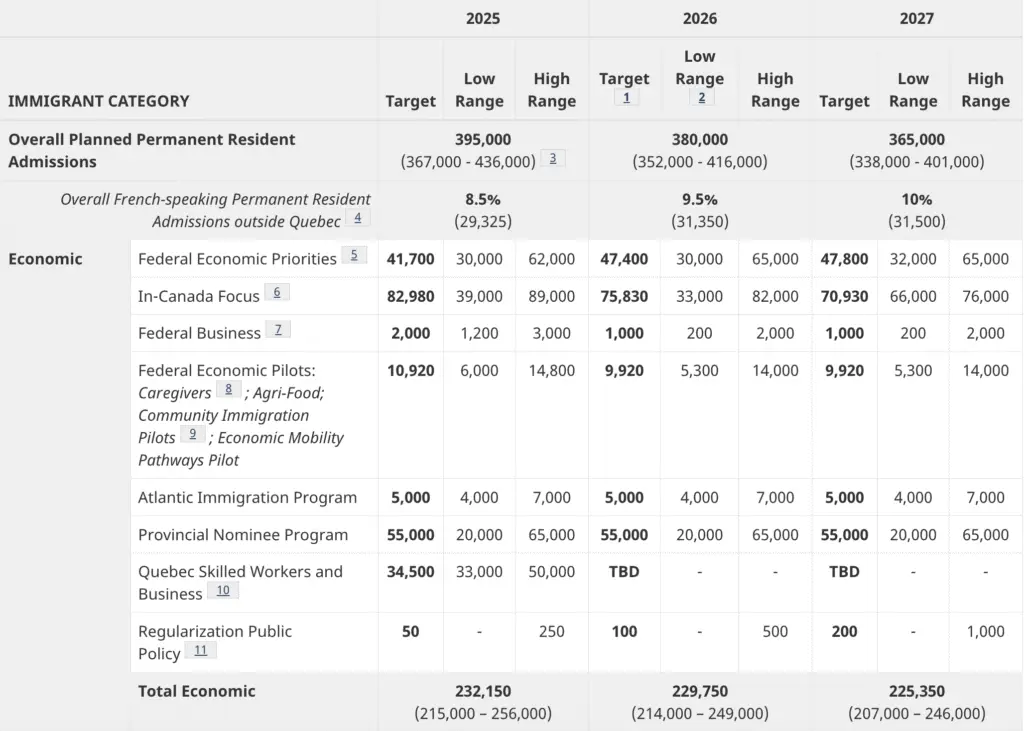
Within this fixed ceiling, the new plan assigns a larger share of spaces to the economic class. It allocates 239,800 economic admissions in 2026 and 244,700 in both 2027 and 2028, compared with 229,750 in 2026 and 225,350 in 2027 under the earlier plan. Higher allocations for Federal High Skilled and Provincial Nominee Program applicants drive most of this increase.
“Federal High Skilled” refers to admissions through the Express Entry system, which includes the Federal Skilled Worker Program, Federal Skilled Trades Program, and Canadian Experience Class. Each year, IRCC sets Express Entry categories based on labour market information, projections, and input from provinces, territories, and other partners to select candidates with the skills, training, and language ability needed to respond to labour-market needs.
The plan also increases the targets for French-speaking admissions outside Quebec, setting them at 9 percent in 2026, 9.5 percent in 2027, and 10.5 percent in 2028. The numbers shown in the table represent how many admissions outside Quebec are needed to meet these percentages. Since Quebec controls the selection of immigrants destined for the province under the Canada-Quebec Accord, IRCC calculates these figures using only the portion of permanent resident admissions destined for the rest of Canada.
These numbers may be updated after Quebec tables its own annual levels plan for 2026. The practical takeaway is that IRCC is reserving a larger share of permanent resident places for French-speaking candidates outside Quebec, making French-language proficiency a more important factor in economic immigration pathways.
The practical implications for applicants are more concrete than they appear at first glance. Economic-class candidates in Federal High Skilled and Provincial Nominee Program streams are the clear beneficiaries of the new plan. Both streams receive higher admissions targets than in the earlier plan, which means these programs now have more room relative to other categories.
For Express Entry candidates, this may translate into more frequent or more targeted draws, particularly in labour-market categories and French-language categories that support the rising Francophone targets. For those considering PNP pathways, the expanded allocations give provinces more capacity to issue nominations, which can strengthen a candidate’s prospects if their profile aligns with provincial needs.
By contrast, family-class admissions remain flat at 81,000 per year, and the humanitarian and protected persons categories hold steady at 49,300. There are no increases in these streams, so applicants in those categories do not see additional space.
Anyone planning their route to permanent residence should evaluate how these expanded economic and Francophone allocations align with their qualifications, whether their occupation or language ability fits current federal and provincial priorities, and whether a PNP nomination, French proficiency, or a category-based Express Entry draw could improve their position within a system that is capped overall but now more heavily weighted toward economic and Francophone selection. En d’autres termes, il pourrait bien être temps d’apprendre le français.
One Time Recalibration Measures: Permanent Residence for Protected Persons & Certain Temporary Workers
Beginning in 2026, the federal government will introduce two one-time initiatives that operate alongside the regular permanent resident system. These pathways are framed by IRCC as part of a broader “recalibration” effort, and they represent a clear departure from the earlier 2025 – 2027 plan, which contained no comparable allocations.
Under the new plan, regular permanent resident admissions remain fixed at 380,000 for 2026 through 2028, but IRCC will also process approximately 115,000 applications from protected persons and up to 33,000 temporary workers will be fast tracked to permanent residence over 2026 and 2027. These additions raise questions about how total admissions will be counted during a period when the government is holding permanent resident levels steady and is attempting to stabilize the broader system.
The implications for protected persons are the clearest. IRCC confirms in their Supplementary Information that the roughly 115,000 protected persons who will transition over 2026 and 2027 are being processed in addition to the regular permanent resident targets.
This separates the protected persons inventory from the capped system, something the previous 2025 to 2027 plan did not do. By giving protected persons their own two-year allocation, IRCC can reduce the inventory without displacing applicants in economic, family or resettled refugee categories. For individuals awaiting permanent residence through protected person status, the change creates a more predictable path at a time when the government is holding the rest of the system steady.
The temporary worker measure is narrower, and its interaction with the permanent resident cap is less certain. IRCC plans to transition up to 33,000 workers who already have strong ties in Canada and who work in sectors identified as important to the economy, including rural and regional labour markets. IRCC has not explicitly stated whether these admissions will be counted outside the 380,000 permanent resident ceiling.
However, it’s worth noting that the Financial Post reported in its article titled “Canada’s new immigration targets likely higher than headline number” that an IRCC spokesperson indicated that both one-time measures are in addition to the Immigration Levels target. However, it’s important to note that this is not stated directly in IRCC’s official published documents.
Even so, we can be cautiously optimistic because the structure of the plan leaves open the possibility that these transitions may also be treated separately, because the regular permanent resident target does not appear to adjust to accommodate them from the information available.
For those who may fall within these measures, the announcement is welcome news. For protected persons, the prospect of a clearer path to permanent residence offers a real opportunity to finally secure stability and truly call Canada home. This measure reflects Canada’s long-standing commitment to protection, humanitarianism and justice, and it comes at a moment when many have been waiting for meaningful progress.
Alongside this, certain temporary workers may also gain an opportunity that did not exist under the earlier plan. While key details have not yet been officially released, there is good reason for cautious optimism, and we now await further information on how these two one time measures will be put into practice.
Canada Cuts Temporary Resident Arrivals to Meet Its Five Percent Target
The federal plan to bring the temporary resident population below five percent of Canada’s total population by the end of 2027 now plays a central role in how temporary pathways will operate for the foreseeable future. The earlier 2025 to 2027 plan, set under the Trudeau government, projected far higher temporary resident arrivals. Budget 2025 notes that temporary residents accounted for 7.5 percent of Canada’s population in 2024, up from 3.3 percent in 2018, and connects this growth to pressure on housing and public services. The new 2026 to 2028 plan, introduced by the Carney government, responds by lowering the number of new temporary resident arrivals to levels well below those previously projected.
For many prospective workers and students, the shift feels abrupt and discouraging, and those reactions are understandable given how central temporary pathways have become to Canada’s immigration framework and how temporary workers have long helped fill labour gaps in essential sectors.
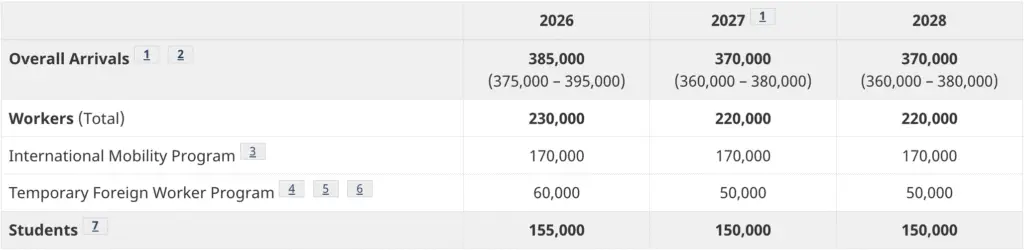
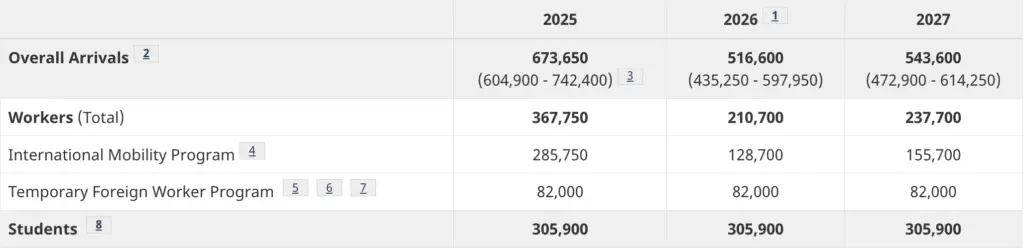
Under the earlier plan, Canada projected 516,600 temporary resident arrivals for 2026 and 543,600 for 2027. The new plan reduces those targets to 385,000 in 2026 and 370,000 in both 2027 and 2028. These represent reductions of roughly one quarter in 2026 and approximately one third in 2027. The largest adjustment appears in the international student stream.
The earlier plan set 305,900 new study permit holders for both 2026 and 2027. The new plan reduces these figures to 155,000 in 2026 and 150,000 in each of the following two years. This narrows the share of students within the temporary resident category. Under the earlier plan, students represented about 59 percent of temporary resident arrivals for 2026. Under the new plan they represent about 40 percent.
Worker arrivals shift in a more mixed way, although the overall direction remains downward when compared with 2025 levels. The Trudeau government’s 2025 target for new temporary workers was 367,750. Under the 2025 to 2027 plan, worker arrivals were projected at 210,700 in 2026 and 237,700 in 2027. The Carney government’s new plan sets worker targets at 230,000 in 2026 and 220,000 in both 2027 and 2028.
The composition of these workers is also notable. The International Mobility Program (“IMP”) covers work permits that do not require a Labour Market Impact Assessment (“LMIA”) and are issued for reasons such as international agreements, reciprocal benefits, and broader economic or cultural interests. The Temporary Foreign Worker Program (“TFWP”) is employer driven and generally requires an LMIA to demonstrate that no Canadian workers are available. Under the earlier plan, the IMP accounted for 128,700 workers in 2026, whereas the new plan sets this at 170,000.
TFWP numbers experience a sudden drop from 82,000 in 2025 to 60,000 in 2026 and then hold relatively stable at 50,000 in 2027 and 2028. These shifts reflect the government’s attempt to rebalance temporary labour intakes while maintaining capacity in sectors that rely on foreign workers.
For future temporary workers, these changes mean that applications will be assessed within a more selective system, and officers may look more closely at how the information provided relates to Canada’s current labour priorities. Federal documents identify ongoing demand in sectors such as health care, construction, agriculture, and transportation.
Presenting clear information about experience in these areas may help officers understand how an applicant’s background connects to labour needs identified by the government. While each application is evaluated on its own facts, organizing information transparently and explaining the applicant’s experience in a straightforward way can assist officers in assessing the file within the parameters of the new plan.
International students face a particularly constrained environment. With projected arrivals reduced by roughly half compared with the earlier plan, the contraction in student spaces is substantially greater than the adjustments made to worker numbers. In this context, officers may scrutinize study permit applications more closely and consider a broad range of factors, including how a proposed program fits within an applicant’s academic or career path and whether the information provided presents a coherent purpose for study in Canada. Eligibility elements such as financial capacity, ties abroad, and the overall credibility of the materials submitted remain central to the assessment.
Provincial Attestation Letters, while not new, now operate within tighter provincial limits that affect how many new students each province can accommodate, making provincial capacity an additional factor in the process. Each application is reviewed on its own merits, and while there are no guarantees, clear and consistent information can help officers understand how the file fits within a system that has become considerably more selective for students.
The most consequential change in the 2026 to 2028 Immigration Levels Plan is its clear departure from the much higher temporary resident projections in the 2025 to 2027 plan, sharply reducing overall volumes and reshaping the balance between students and workers.
These shifts create a more selective environment across all temporary pathways, and applicants now face a system that places greater emphasis on clarity of purpose, labour market relevance, and overall program fit. Applicants cannot control these policy choices, but they can control how effectively they present their information and how clearly they demonstrate alignment with federal and provincial priorities. In this context, a well organized application that explains the applicant’s background, objectives, and supporting evidence in a coherent way can help officers understand how the file fits within the framework described throughout this section.
Contact Forghani Law
Canada’s immigration priorities have shifted, and the landscape applicants face today is not the same as it once was. Understanding how these priorities have changed, and how they shape your own plans, is an essential part of navigating the system in its current form.
If you’d like to discuss your particular circumstances, explore how these changes may relate to your situation, or if you simply want help with your immigration goals, you are invited to request a consultation or complete our free assessment form.
