
On January 30, 2025, Immigration, Refugees and Citizenship Canada (“IRCC”) announced the launch of the Rural Community Immigration Pilot (“RCIP”) and the Francophone Community Immigration Pilot (“FCIP”). These Canadian immigration programs provide skilled workers and certain recent graduates with a pathway to permanent residence by connecting them to designated rural and Francophone communities across Canada that are looking to fill labour shortages and support regional growth. This article focuses on the RCIP.
Unlike most traditional immigration streams, the RCIP allows selected rural communities to actively participate in the selection of newcomers. Local economic development organizations in 14 designated communities are responsible for identifying key labour gaps, designating employers, and recommending eligible candidates for permanent residence. For skilled workers and international graduates, the RCIP is an opportunity to establish a future in a Canadian rural community and contribute to the local economy.
What is the Rural Community Immigration Pilot?
The RCIP is an immigration program that offers eligible skilled workers and recent graduates a route to Canadian permanent residence by connecting them to one of 14 participating rural communities. Each community works with IRCC to designate employers and recommend candidates for permanent residency. The RCIP and the FCIP are designed to attract and retain newcomers in regions with critical labour shortages, offering alternatives to the traditional Express Entry system for those seeking to immigrate to Canada’s rural and Francophone communities.
RCIP Eligibility Criteria
To qualify for the RCIP, applicants must meet specific eligibility requirements designed to support community-driven economic immigration. This pathway is ideal for skilled workers and qualifying international graduates seeking permanent residence in rural Canada.
- Job Offer: You must have a full-time, permanent job offer from an approved employer in one of the 14 participating rural communities.
- Work Experience: You need at least one year of full-time work experience within the last three years in a qualifying job. However, an exemption may exist if you’re an eligible recent graduate who studied and graduated in the community and meet certain criteria.
- Education: You must have a Canadian high school diploma or higher, or a foreign credential that is equivalent, supported by a valid Educational Credential Assessment (“ECA”) from an IRCC-approved organization.
- Language Skills: You must prove your ability to speak English or French by taking an approved language test.
- Financial Support: You must show you have enough money to support yourself and your family.
- Community Recommendation: Once you have a valid job offer from a designated employer, the community will review your application to confirm your job is genuine and in a priority sector. If you meet all program requirements and receive a recommendation, you can apply for permanent residence.
List of RCIP Participating Communities
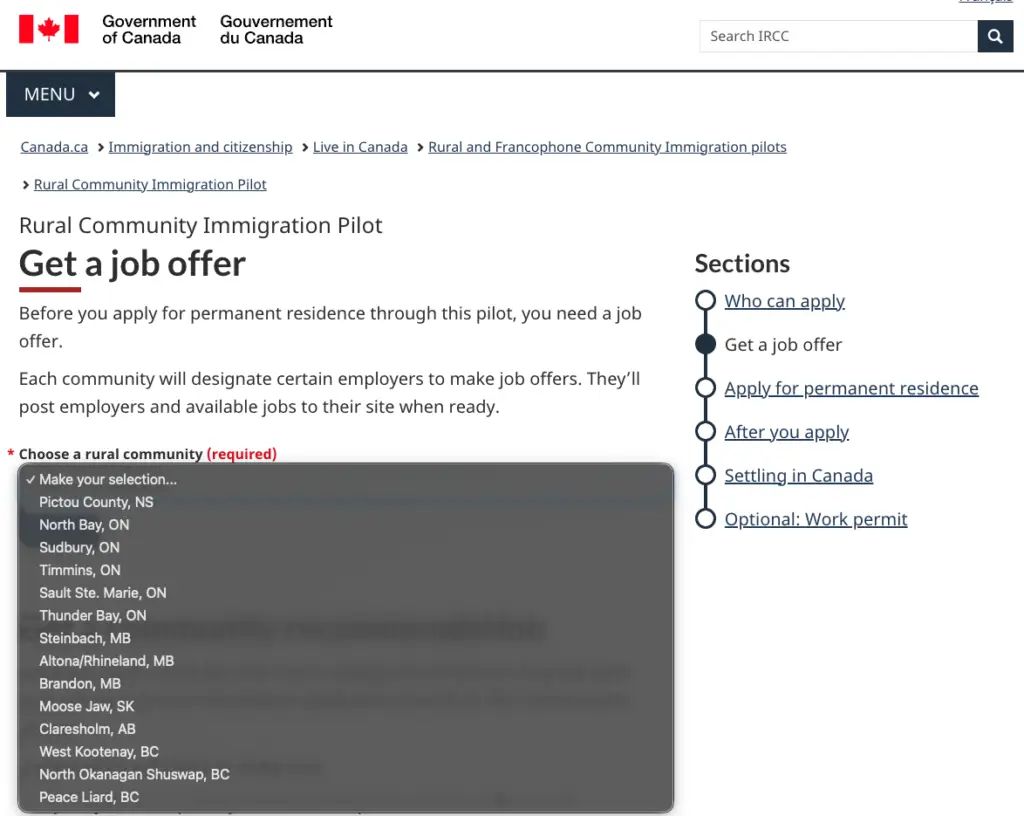
As of the date of this article, there are 14 designated rural communities currently participating in the RCIP. Each community is supported by a local economic development organization responsible for selecting employers and recommending eligible candidates for permanent residence. To qualify under the RCIP, your job offer and community recommendation must come from one of these communities:
Nova Scotia: Pictou County
Ontario: North Bay, Sudbury, Timmins, Sault Ste. Marie, Thunder Bay
Manitoba: Steinbach, Altona/Rhineland, Brandon
Saskatchewan: Moose Jaw
Alberta: Claresholm
British Columbia: West Kootenay, North Okanagan-Shuswap, Peace Liard
Since community participation is subject to change, always consult IRCC’s website for the latest details.
Community Role and Employer Designation
The RCIP utilizes the direct involvement of local communities. To apply, candidates need a job offer from an employer approved by the community’s economic development organization. Not every employer is eligible, and each community has its own process for designating employers and supporting newcomers.
In addition to a job offer, applicants must secure a community recommendation. Communities assess whether candidates meet local needs and are likely to settle successfully. The process may involve additional steps or requirements that vary by location.
RCIP Work Permit: What You Need to Know
If you have applied for permanent residence through the RCIP, you may be eligible for a two-year work permit. This RCIP work permit allows skilled workers and qualifying international graduates to start working in Canada while their permanent residence application is being processed.
Key details about the RCIP work permit:
- It is valid for up to two years.
- Employer-specific and community-specific: You can only work for the designated employer in the rural community that provided your job offer and recommendation.
- Eligibility requirements: You must have an eligible job offer from a designated employer, a community recommendation, and meet the general requirements to apply for a Canadian work permit.
If you have a spouse or common-law partner, they can also apply for an open work permit, which allows them to work for any employer within the same community.
Contact Us Today
Living in a rural Canadian community through the Rural Community Immigration Pilot can offer the opportunity for newcomers to be part of a welcoming and close-knit community, where you are valued as a neighbour, colleague, and community member. Many people discover that rural Canada provides a strong sense of belonging, an excellent quality of life, and unique opportunities to build meaningful connections while making a real contribution to their new home.
If you’re interested in immigrating to Canada as a permanent resident through the RCIP or want to learn more about your options, contact Forghani Law to schedule a personalized consultation. Our team can help you understand how the RCIP may apply to your circumstances and support you in taking the next step toward your future in Canada.
Our Free Assessment Form: CLICK HERE
Request a Consultation: CLICK HERE
